The Best Time to Post on X (and How to Find Yours)
Generic best-time-to-post charts are averages of strangers. Here is why timing still matters on a ranked timeline, and a repeatable method for finding the windows that work for your account.
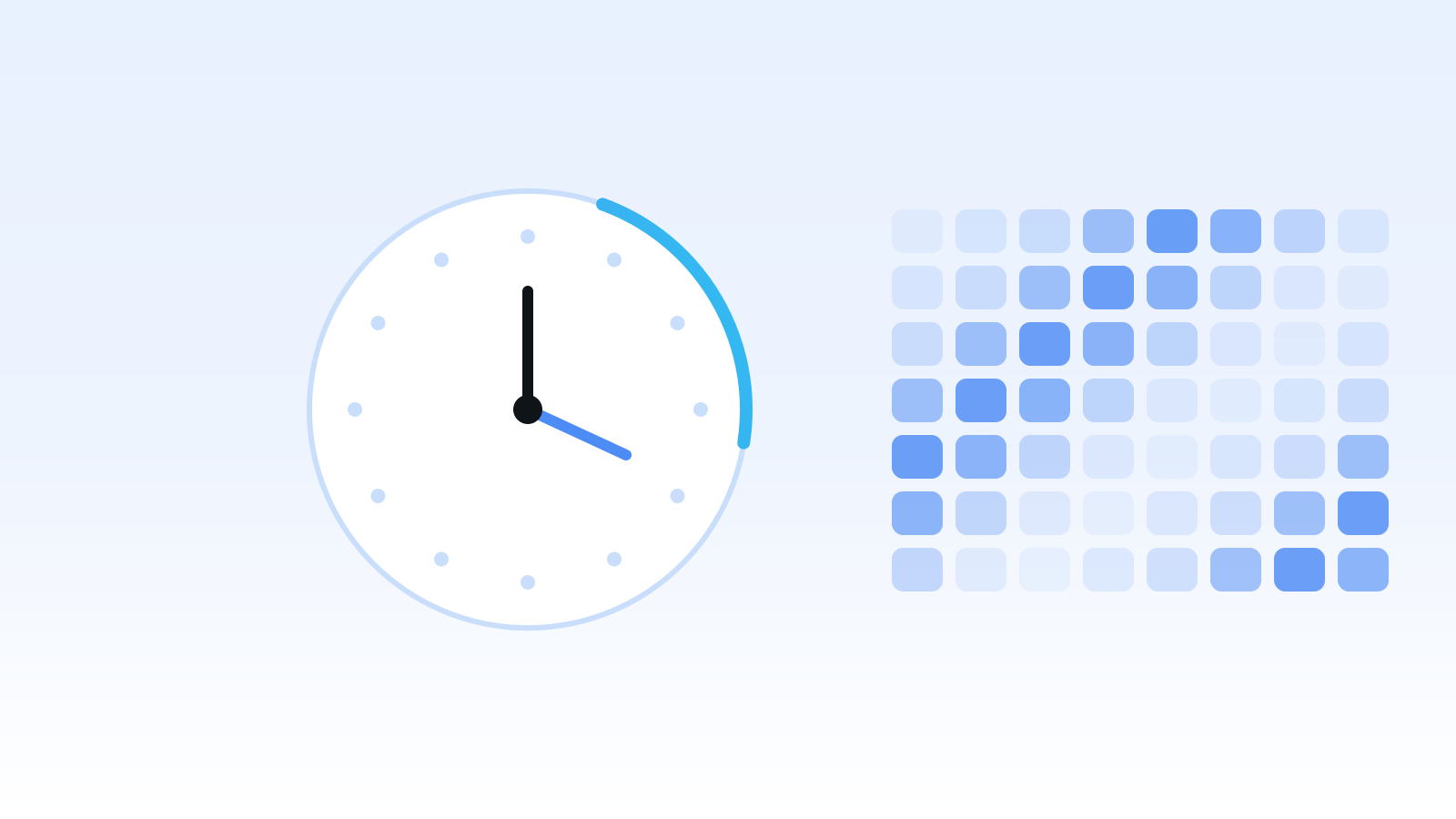
Every best time to post chart you have seen is an average of accounts that are not yours. They are usually built from a large sample across every category and every timezone, which makes them a reasonable place to start and a terrible place to stop. Your audience has one timezone distribution, one set of habits, and one topic — and those beat the global average every time.
The more interesting question is whether timing matters at all now that the For You timeline is ranked rather than chronological. It does, but for a narrower reason than it used to.
Why timing still matters on a ranked feed
Two mechanics keep the clock relevant. First, candidate sourcing favours recent posts — a post has a window in which it is eligible to be pulled into timelines at all, and that window is measured in hours, not days. Second, the ranking model is heavily influenced by early engagement, because early engagement is the best available evidence that a post is worth showing to more people.
Put those together and the practical rule is simple: post when the people most likely to engage are awake and in the app, so the first thirty to sixty minutes produce real signal. You are not trying to catch a chronological feed. You are trying to make sure the model has something to score.
The rough starting points
If you have no data yet, start with the patterns that hold across most professional and creator audiences, then test your way off them.
- Weekday mornings in your audience's main timezone, around the start of the working day, tend to be the densest window for business and tech audiences.
- Early evening on weekdays is the second dense window, and it skews more casual and more conversational.
- Mid-afternoon is usually the weakest weekday window in most categories.
- Weekends are quieter in absolute terms but far less competitive, which for a small account is often a better trade than raw volume.
Treat all four as hypotheses. The point of a starting point is that it gives you something to disprove.
Finding your own windows
This is a three-week exercise and it is worth the effort exactly once, because the answer is stable for months.
- Pick four candidate windows and nothing more. Two morning, two evening, spread across weekdays and one weekend slot.
- Post the same kind of content in each. Comparing a thread against a one-liner tells you about format, not timing. Hold format constant or the experiment is worthless.
- Log impressions at a fixed age — the number 24 hours after posting, not whenever you happen to look. A post checked at three hours and one checked at three days are not comparable.
- Run each window at least four times. Post-level impressions are spiky enough that a single result tells you nothing.
- Compare medians, not averages. One post that travelled will drag an average up and hide the pattern completely.
If you have a professional account, your own analytics already hold most of this. Export the post data, bucket it by hour of day and by weekday, and look at the median impressions per bucket. Three weeks of honest logging beats any published chart.
Where audiences actually are
One check most people skip: find out where your followers are before optimising for a clock. If a meaningful share of your audience is several timezones away from you, your comfortable posting hour may be their middle of the night. Accounts that grew through replies under large international accounts are especially prone to this — the audience arrived from somewhere else.
You do not need to serve everyone. Pick the timezone that holds the largest share of the people who actually engage with you, and post for them. Splitting the difference between two distant regions usually serves neither.
Scheduling, and what it costs you
Scheduling tools solve the obvious problem — they let you hit a window you are not awake for — and they create a less obvious one. The first hour is exactly when replying matters most, and a scheduled post that goes out while you are asleep spends its most valuable hour unattended. You get the timing and lose the conversation, which is the more heavily weighted of the two.
The workable compromise is to split your posting by stakes. Schedule the routine posts into whatever window your data likes; hand-post the ones you actually care about, at a time you can sit with them for half an hour. If a post is worth writing properly, it is worth being present for.
One more thing no chart can account for: the news cycle beats the clock. A good post published into an hour when something large is breaking in your niche gets buried regardless of how well that hour usually performs, because the competition for attention has changed underneath you. Check what the room is talking about before you publish something you only get one shot at.
What timing cannot fix
Timing is a multiplier on a post that already had something to offer. If your posts are not getting replies at any hour, the window is not the problem — the format or the topic is, and the honest fix is upstream. The same is true if reach fell off a cliff across every post at once, which is a different diagnosis entirely and covered in why your impressions dropped.
The bottom line
Start from the common windows, then spend three weeks proving which of them is yours. Hold format constant, measure at a fixed post age, compare medians, and commit to the winner. That is a couple of hours of work for a result that keeps paying every time you post.